We understand that Toronto City Councillor Jon Burnside has proposed a motion calling on Toronto Police to confiscate e-bikes and e-scooters from people who ride them on sidewalks. The latest salvo in the ongoing fracas e-bikes engender. That said, the seizure of property is unprecedented.
No doubt concerns raised by people worried about their safety as they navigate strollers and walkers or even just quick paced jaunts to their local coffee shop have fueled this motion. Those concerns are valid, but they must be viewed within the larger context of road safety in Toronto.
We have 2 or 3 cases involving e-bike riders colliding with cyclists resulting in injury, but we have hundreds of cases of cyclists and pedestrians being hit by motorists.
Safety concerns shroud Councillor Burnside’s escalation in the targeting of electric mobility device users (e-bike and e-scooter riders). However, aside from the odd case here and there, collisions involving pedestrians and people riding on sidewalks has not resulted in widespread serious injury, and certainly no incidents resulting in death. At least, we know of no corresponding data.
If safety is our concern, then aggressive, proactive (albeit probably unlawful) plans like this should be directed at the main perpetrators of harm on our roadways. This year alone, motorists have been involved in collisions that have resulted in[1]:
35 Deaths:

199 Serious Injuries:
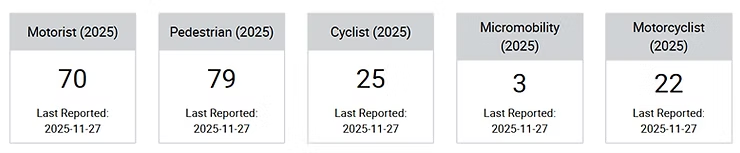
On the eve of Councillor Burnside proposing his motion a 70-year-old pedestrian was struck and killed by a motorist in Scarborough[2].
If we are serious about tackling safety issues in our community, we must do so with an evidence-based approach. If we have limited resources, their use must achieve statistically significant results and positive impacts on our communities.
If you start impounding e-bikes, people may feel safer, but they won’t be.
Until we direct this kind of effort and energy at dangerous drivers, injury and death on our roadways will remain prolific.
That is not to say we should not invest time in ensuring all road users act appropriately.
We should engage in public education campaigns. However, Councillor Burnside (seemingly without any evidence) suggests efforts this past fall by City of Toronto targeting “Rideables” (read e-bikes) were not successful[3]:
“At City Council on October 8 and 9, 2025, direction was provided for a public education campaign and enforcement blitzes. Sadly, more enforcement power (seizing of items) is needed to reinforce the messaging as the number of injuries is increasing.”
Perhaps the Rideables Campaign was or was not success. There does not seem to be any data or reporting on that. Councillor Burnside’s comment that the number of injuries is increasing sounds concerning but appears to be baseless.
In any case, it’s probably unlikely that limited attempts at public education will result in widespread positive changes in behaviour. It’s likely that even after repeated “don’t block the box” campaigns[4], some people are still blocking the box. It doesn’t mean we give up on that campaign; we just must acknowledge that breaking bad habits may take time and effort. To that end, we support continued public educations campaigns.
In concert with public education efforts, why not also go straight to the source. Delivery platforms like Uber and Skip the Dishes employ thousands of e-bike couriers in Toronto. What efforts have been undertaking to interface with those companies?
If you are employing and (we’d argue) incentivizing dangerous behaviours, there is an onus on those companies to ensure their operators are not endangering themselves or other road users. Targeting individual and precariously employed e-bike riders will not be as effective as working directly with Uber to ensure riders have road safety training and are incentivized/reminded to obey the rules of the road.
Uber and other rider share drivers must undergo City of Toronto approved training to operate in Toronto[5]. Perhaps a similar approach should be taken with their delivery riders.
Finally, but perhaps as important are the undertones of race and inequality that seem to fuel these disproportionate efforts to target e-bikers. A sense of “othering” creeps into many discussions around this issue. Noticeably, many people who use e-bikes are precariously employed racialized young men, in many cases new to Canada.
This targeted and aggressive approach aimed at those people would never be aimed at Torontonians with more privilege, car owners.
It seems unlikely that Councillor Burnside would propose confiscating motor vehicles from people who run red lights, rush pedestrians at crosswalks, blow by open streetcar doors, etc.
Given the inequities at play, we question whether increased police involvement has been considered from that perspective, with a mind to potential harms. TPS has acknowledged that racialized Torontonians experience use of force interactions at rates far higher than white Torontonians[6]. The City of Toronto too has gone to great lengths to promote equality[7].
It seems odd then to direct a police force with known systemic racism problem at a group of young, racialized men. Why not avoid the apology years from now when the data from these interactions demonstrates at best racial bias but perhaps also incidents of police violence.
The policing focus of Councillor Burnside’s motion must be viewed through a resource allocation lens as well. The City of Toronto has again approved an increase to the police budget, nearly $100 million this year[8]. The increase was apparently required to add new officers, presumably to deal with serious crime, call response times and pressing public safety issues in Toronto. We have now raised the police budget to almost $1.5 billion. It is incumbent upon Council to ensure that that massive expenditure is properly directed.
Sending multiple officers out to detain e-bike riders and confiscate e-bikes will not only be a drain on manpower and policing time but is likely to become a bureaucratic nightmare.
We cannot even properly prosecute cases of dangerous drivers causing serious injuries to vulnerable road users[9]. How possibly can the City of Toronto manage this confiscation campaign. The storage requirements of confiscated vehicles alone should give us all pause.
We could reference the precarious legality of this proposed program but will leave it with a plea to consider the faulty road safety basis for and the likely inequities that will result from such a campaign.
We would be happy to discuss any of the above with your offices.
Kind Regards,

Dave Shellnutt
Lawyer & Advocate
[1] Vision Zero Statistics (City of Toronto).
[2] Pedestrian Killed (CTV News).
[3] Rideables Campaign (City of Toronto).
[4] Don’t Block the Box (CBC).
[5] Uber Driver Training (Uber).
[6] Use of Force (BBC).
[7] EDI Statement (City of Toronto).
[8] TPS Budget Increase (TPS).
[9] Court System in Shambles (The Star).