Dear Honourable Mayor Guthrie and Council Members,
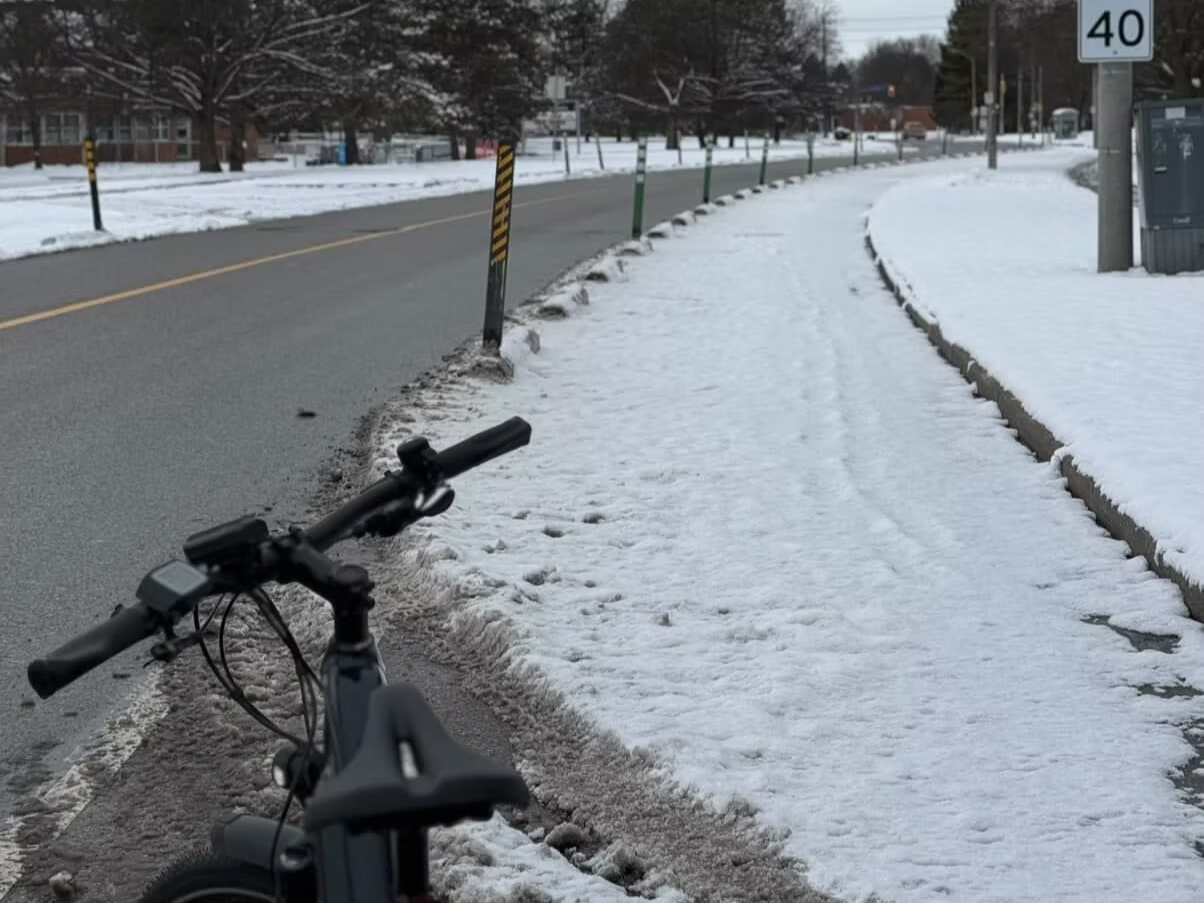
We have closely monitored the debate about bike lane winter maintenance in Guelph. The implications of the recent City Council 7 to 6 vote to not clear snow and ice from frequently used public roadways will make riding a bicycle less safe in Guelph. Forcing cyclists out of bike lanes into motor vehicle traffic during treacherous winter conditions will increase conflict amongst road users and the likelihood of serious injury.
We heard from Councilors Gibson and Chew, ultimately backed by Mayor Guthrie who were against maintaining Guelph’s cycling infrastructure this winter. Cllr. Chew noted that cycling was seasonal. Cllr. Gibson inferred that since a guy he knows thinks you should not ride a motorcycle in winter, countless people in Guelph should avoid cycling as an entirely different and more viable mode of transportation.
Notwithstanding these assumptions, we suspect Council has not considered the potential liability implications in failing to maintain public roads in a reasonable state of repair.
Please consider this letter as notice of your duties under the Municipal Act, 2001, S.O. 2001, c. 25, and the increased likelihood of claims made against the City of Guelph should any cyclist or other vulnerable road user be injured as a result (in whole or in part) of a bike lane not being properly cleared, salted and maintained this winter. If someone is injured because of your negligence and failure to comply with your Municipal Act obligations and we are retained, we can assure you of our intention to aggressively seek compensation for their injuries from the City of Guelph.
Municipalities in Ontario have a duty to keep public roads in a reasonable state of repair.
Section 44(1) of the Municipal Act provides that the municipality that has jurisdiction over a highway or bridge shall keep it in a state of repair that is reasonable in the circumstances. Section 44(3) limits the scope of this duty and provides the municipality with three statutory defences to allegations it did not properly maintain highways or bridges:
Despite subsection (2), a municipality is not liable for failing to keep a highway or bridge in a reasonable state of repair if,
(a) it did not know and could not reasonably have been expected to have known about the state of repair of the highway or bridge;
(b) it took reasonable steps to prevent the default from arising; or
(c) at the time the cause of action arose, minimum standards established under subsection (4) applied to the highway or bridge and to the alleged default and those standards have been met.
None of these defences permit the wholesale abandonment of winter maintenance for budgetary or other reasons. Most bike lanes in Guelph are on the roadway.
Further proof of a municipalities obligation to clear and salt bike lanes is found in the Minimum Maintenance Standards:

Additionally, municipalities are obligated to prevent ice formation or treat ice on bicycle lanes, the same way the adjacent roads are treated:
The City’s Council cannot abdicate your statutory duties to maintain roadways in Guelph.
The City of Guelph may argue that the decision to not clear snow and ice from bike lanes all winter is a policy decision, dictated by budgetary constraints.
However, jurisprudence clarifies that the decision to clear snow from one part of the roadway and not from another is an operational decision (open to liability) and not a core policy decision (immune from liability).
Please review Nelson (City) v. Marchi, wherein the Supreme Court of Canada (SCC) explained that core policy decisions are immune from negligence liability because each branch of government has a core institutional role and competency that must be protected from interference by the other branches.
However, the SCC clarified that ‘the mere presence of budgetary, financial, or resource implications does not determine whether a decision is core policy — too many government decisions, even the most operational decisions, involve some consideration of a department’s budget or the scarcity of its resources […] Whether a government decision involved budgetary considerations cannot be a test for whether it constituted core policy; it is but one consideration among many.’
In Marchi, the plaintiff was injured while attempting to cross a snowbank created by the City of Nelson snow clearing staff. Ms. Marchi sued the City of Nelson for negligence. Dismissing her claim, the trial judge concluded that the City did not owe Ms. Marchi a duty of care because its snow removal decisions were core policy decisions.
The Court of Appeal concluded that the trial judge erred and the SCC agreed.

The City of Nelson asked the Court to confirm that its written and unwritten “snow clearance and removal policies” were core policy decisions because they involve allocating scarce resources in circumstances where not all stakeholders can be satisfied at once.
Instead, the SCC confirmed that inviting members of the public to use parking stalls without clearing a path to the adjacent sidewalks was operational and attracted liability:
Insulating these kinds of decisions from negligence liability does not undermine the ability of governments to make important public interest policy choices. The public interest is not served when ad hoc decisions that fail to balance competing interests or that fail to consider how best to mitigate harms are insulated (from review). Oversight of such decisions respects the relevant roles of each branch of government.
It is conceivable that this line of reasoning would apply to Guelph’s bike lanes. Inviting people to use bike lanes in Guelph while failing to clear access to those bike lanes would be an operational decision.
Over the years, the City of Guelph created a commendable cycling grid and encouraged cyclists to use this safer infrastructure. Likely, a court would uphold this longstanding principle: if you build it, you must maintain it. If Guelph knowingly encourages people to use bike lanes, but then allows hazards to persist in those lanes, the City may be responsible for the consequences that flow from municipal inaction.
We respectfully request that the City of Guelph consider the legal implications and possible ramifications and costs incurred by taxpayers for likely litigation that could result from the creation of hazardous roadways.
Our office would be happy to discuss this issue in greater detail and with the aim of cooperation and collaboration, outside of the courtroom, and in the interests of all.
Kind Regards,
Dave Shellnutt
Lawyer & Advocate
Cc: local partners and news media.